AI reads your data before it reads your campaign.
An AI-personalized send congratulates a VP on the job title she left in 2021. The model did exactly what it was told. It read the record and acted on it. The record was the problem.
An AI-personalized campaign goes out to four thousand contacts at nine in the morning. One opening line congratulates a VP of Engineering on the coordinator role she left in 2021. A few hundred others reference a company name that changed in an acquisition eighteen months ago.
Nobody wrote those lines. The AI did, fluently and with complete confidence, from the fields it was handed.
The instinct afterward is to examine the tool. That is the wrong place to look. The model did what it was asked, read the record, and acted on it. The record was the problem.
The dependency quietly inverted
For fifteen years the marketing stack was built around one job: getting the right message out the door. The campaign builder, the automation platform, the nurture tracks, the attribution dashboard. Every layer assumed a human designs the campaign and the tools execute it.
AI moves the decision upstream. A personalization engine, a scoring model, a routing agent: none of them consume campaigns. They consume records. What they read determines what they do, and they read everything with equal confidence.
That shift is already at scale. Gartner surveyed 413 marketing technology leaders in mid-2025 and found 81% were either piloting or had already implemented AI agents. At the same time, Gartner’s 2025 Marketing Technology Survey puts stack utilization at 49%, with only 15% of organizations qualifying as high performers.
Now set that against readiness. Gartner found 63% of organizations either lack the data management practices AI requires or do not know whether they have them, and predicts that through 2026 organizations will abandon 60% of AI projects unsupported by AI-ready data.
The tools arrived. The substrate did not.
A decade of debt nobody had to pay
Every marketing database carries the same sediment. Duplicates across the CRM and the automation platform. Free-text inputs where a picklist belonged. Five spellings of the same industry. Contacts who went quiet in 2022 and were never suppressed. Enrichment that replaced a good value with a worse one and left no trace.
None of it was urgent, because a person sat between the data and the decision. A campaign manager who spots the same buyer sitting in two records merges them by eye and moves on. Judgment covered the gap.
AI removes that layer. It treats every value as true and acts on it thousands of times before anyone notices a pattern. The debt was always there. AI just started drawing on it at volume.
Which makes an idea from an earlier piece more literal than it first sounds: your systems are a mirror of what you actually sell. Your database is now a live readout of whether your AI can function at all.
The job moved
McKinsey’s State of AI survey found 88% of organizations using AI in at least one function and 39% reporting any earnings impact. Among the small group seeing real value, the strongest differentiator was not the model or the budget. High performers were nearly three times more likely to have fundamentally redesigned their workflows instead of layering AI onto the ones they had.
For marketing ops, that redesign is not another tool evaluation. It is the data layer.
The work used to be building the send: audience, logic, template, QA, deploy. That work still exists, and AI absorbs more of it each quarter. What AI cannot absorb is deciding what counts as a valid value, which source wins a conflict, and what a machine is permitted to act on.
Campaign operator becomes data steward. It reads like a move toward plumbing. It is closer to the opposite. Whoever governs the fields determines whether every AI initiative in marketing produces pipeline or an apology.
That shift is observable, not theoretical. Anthropic published how its own marketing operations team now works. Ian Chan used to spend one to two days a week assembling the weekly marketing metrics review, chasing numbers scattered across a dashboard, a warehouse, a Slack thread, and a call transcript. A scheduled agent now does the collection, and the review takes up to two hours.
The interesting part is where the recovered time went. Not into more reports. He moved to the data layer, making sure the AI interprets metric definitions and regional structures the same way the warehouse does.
That is the job description changing in public.
What the audit actually looks like
Five categories, none of which requires new budget.
Fields. Sunset anything nothing has written to in twelve months. Convert free-text inputs to governed picklists. Timestamp values so staleness is visible rather than assumed.
Records. Dedupe across the CRM and the automation platform. Name one system of record per object, so conflicts resolve by rule instead of by whichever integration synced last. Suppress contacts with no engagement signal.
Taxonomy. One canonical value list per dimension. Map legacy and enriched values into it. Reject writes that fall outside it, which is what keeps the drift from returning next quarter.
Ownership. Every field the AI reads gets a named owner. Quality reports on the same cadence as pipeline. Enrichment can add, never silently overwrite.
Permissions. The one most teams skip. Decide explicitly which fields the AI may act on and which it may only flag, then log every value it writes. A model that writes unreviewed into the same database it reads from will compound its own errors.
When two systems disagree
That checklist assumes you can name one winner per object. In practice, sources contradict each other constantly, and an agent with no ranking will pick whichever it read last.
So rank them once, in writing, before the agent has to choose.
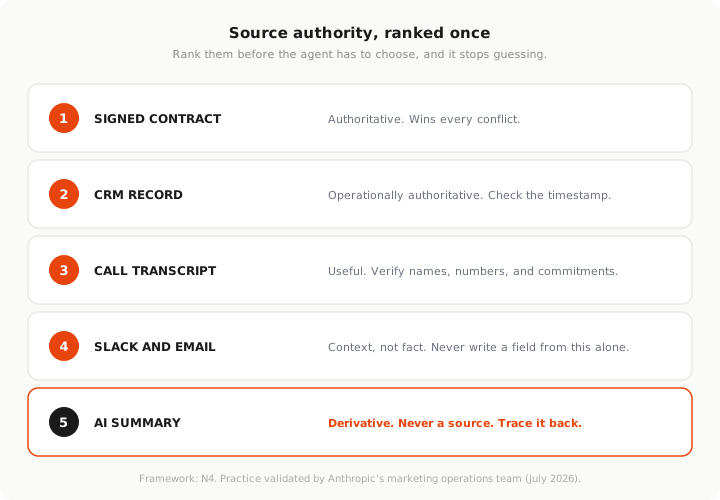
The bottom rung is the one teams miss. An AI-generated summary is derivative by definition. The moment a model treats its own earlier output as a source, errors stop being mistakes and start being history.
Anthropic’s team built the counterweight deliberately. Their reporting workflow runs a dedicated proofreading step that traces every number in a draft back to a verified source, and when figures fail to reconcile the agent surfaces the conflict instead of picking a side. After a sales reorg left the two teams’ reporting misaligned, it raised the gap and asked how to handle it.
Their first piece of advice to other marketing ops teams is to build that verification step before anything else. A separate agent, starting with no prior context, checks the work.
Input and output are two different jobs
These get collapsed, and they shouldn’t be. Reviewing AI output after it runs is its own discipline, and it deserves a standing meeting on the calendar. This is the other half: what the model reads before it produces anything at all.
Both matter. Only one of them is fixable before the damage reaches a customer.
There is a useful symmetry here. Your external content has to be machine-readable so AI engines can find and cite you. Your internal data has to be machine-usable so your own AI can act on it. Same discipline, pointed in two directions. And finding demand that already exists depends entirely on whether your systems recognize the signal when it arrives.
Every job posting in marketing ops still asks for campaign execution, platform administration, and reporting. Fair enough. Those are the visible parts.
The thing that decides whether the next AI rollout works does not appear on any of those descriptions yet.
So before the next tool goes live, run the cheaper test first. Open your database and read it the way the model is about to. What would it conclude about your customers?